AI Agents Explained: A Simple Guide for Non-Technical People

AI agents are changing how we interact with technology, becoming the new applications for our AI-powered business environment. These intelligent software systems work behind the scenes in many digital tools you encounter daily, often without you realizing their presence.
What exactly is an AI agent? An AI agent is a software program that interacts with its environment, collects data, and uses that information to perform self-directed tasks that meet predetermined goals. Unlike basic chatbots or simple automation tools, AI agents demonstrate reasoning, planning, and memory capabilities while maintaining autonomy to make decisions, learn, and adapt.
These digital systems process multiple types of information simultaneously—text, voice, video, audio, code, and more. AI agents can operate continuously to review customer returns or analyze shipping invoices, helping businesses avoid costly supply-chain errors. This capability creates new opportunities for organizations to empower their employees and achieve outcomes that were previously difficult to accomplish.
This guide explains AI agents in straightforward terms, examines how they work, and presents real-world examples that demonstrate their practical applications—without technical complexity.
What is an AI Agent?
An AI agent is a smart computer program designed to independently achieve specific goals. These digital assistants can observe their surroundings, process information, and take actions without constant human guidance.
AI agents operate through a three-step cycle: they sense their environment, think about the best course of action, and then execute that action. This mirrors human thought processes but happens at machine speed.
The key difference between AI agents and regular chatbots lies in their capabilities. Chatbots typically follow rigid scripts and handle simple questions based on pattern matching. AI agents possess greater autonomy and can handle complex, multi-step tasks by breaking them down into manageable pieces.
AI agents demonstrate several distinctive capabilities:
Act independently without continuous human instruction
Learn from interactions to improve over time
Adapt their strategies to new circumstances
Collaborate with other agents or humans
Make proactive decisions rather than just reacting
A customer service AI agent can automatically ask questions, search internal documents, and resolve issues independently determining whether to solve the problem itself or escalate to a human.
AI agents function as autonomous teammates rather than mere tools, bringing genuine value to the teams they support. This partnership approach allows organizations to enhance their capabilities while maintaining human oversight where needed.
Key Features That Make AI Agents Work
Effective AI agents rely on sophisticated core features working together. Understanding these fundamental components clarifies how these intelligent systems operate independently.
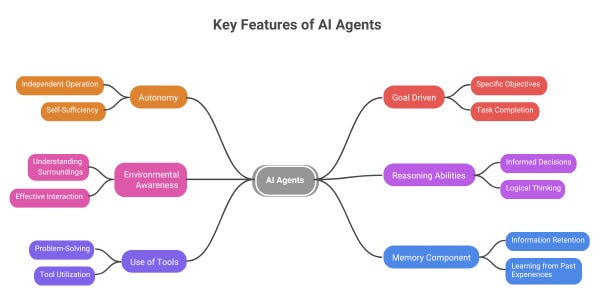
Autonomy: This serves as the cornerstone of AI agents. They can identify and execute appropriate actions without continuous human oversight. Unlike traditional software that follows rigid instructions, AI agents make independent decisions based on historical data and changing circumstances.
Goal-driven: AI Agents are fundamentally goal-driven. They pursue objectives through utility functions or performance metrics, constantly evaluating their actions against defined targets. This purposeful behavior allows them to balance multiple objectives. An AI logistics system, for example, optimizes delivery routes for speed, cost, and fuel consumption simultaneously.
Environmental Awareness: AI agents maintain environmental awareness by gathering data through sensors, digital inputs, or APIs. This perception capability enables them to recognize changes and update their internal state accordingly.
Reasoning abilities: The reasoning abilities that AI Agents possess distinguish them from simpler systems. AI agents combine environmental data with domain knowledge and context to make informed decisions through iterative cycles of thought, action, and observation.
Memory component: The memory component includes both short-term elements (chat history, recent inputs) and long-term storage (customer data, accumulated knowledge). This provides crucial context awareness. Many developers use vector databases or knowledge graphs to store semantically meaningful content for their agents.
Tool use: AI agents extend their capabilities through tool use, connecting to external software, APIs, or devices to perform real-world tasks beyond natural language processing. This integration enables them to send emails, run code, or control hardware when required.
How AI Agents Actually Work
AI agents operate through a structured workflow that mirrors human decision-making processes at machine speed. They begin by determining goals through receiving instructions and breaking them down into actionable tasks. This process involves prioritizing steps based on specific conditions and desired outcomes.
Once goals are established, these systems acquire necessary information by accessing databases, searching the internet, or communicating with other systems. With relevant data in hand, they methodically implement planned tasks, removing completed ones from their queue as they progress.
What truly powers AI agents is their sophisticated memory system. Short-term memory maintains immediate context for conversations, while long-term memory stores historical data through databases or vector embeddings. Episodic memory records specific past experiences: semantic memory retains factual knowledge, and procedural memory handles learned behaviors and skills.
Agents extend their capabilities through tool integration—connecting to APIs, databases, or devices to perform actions beyond language processing. This allows them to send emails, run code, or control hardware when needed.
Advanced AI agent configurations enable collaboration across multiple systems:
Sequential collaboration: Agents pass tasks along defined pipelines
Parallel collaboration: Simultaneous work on different aspects
Hierarchical systems: Supervisor agents manage specialized subordinates
These collaborative structures enable increasingly complex applications across industries. The combination of structured workflows, sophisticated memory systems, and collaborative capabilities allows AI agents to handle multi-faceted engineering challenges that require both autonomous decision-making and coordinated execution.
AI Agents: Beyond Automation
AI agents mark significant advancement from basic chatbots and automation tools. These intelligent systems process multiple types of information while making independent decisions based on their programming. Companies can now automate complex tasks that previously required human intervention.
The applications of AI agents span multiple industries and use cases:
Customer service: Handling inquiries and resolving issues independently
Logistics optimization: Managing supply chains and delivery routes
System collaboration: Working with other agents in complex configurations
Data processing: Analyzing vast datasets to inform decision-making
AI agents function through their core capabilities working together. Their goal-driven approach, combined with environmental awareness and reasoning abilities, enables them to balance multiple objectives simultaneously. Memory systems provide context awareness for making informed decisions.
What sets these systems apart? AI agents can extend their capabilities through tool integration—connecting to APIs, databases, or devices to perform actions beyond language processing. This allows them to send emails, execute code, or control hardware when required.
Multiple agents can collaborate through various configurations. Sequential collaboration passes tasks along defined pipelines, while parallel collaboration enables simultaneous work on different aspects. Hierarchical systems allow supervisor agents to manage specialized subordinates.
AI technology continues to advance, and these agent systems will become increasingly integrated into business operations. Future developments will likely produce more sophisticated systems that handle increasingly complex tasks while requiring less human oversight. AI agents demonstrate how artificial intelligence can augment human capabilities rather than replace them.
And Aekyam is a true example of utilizing AI Agents to advance processes and technology.
Aekyam deploys AI agents that act autonomously in real time, handling specific tasks like inventory checks, route adjustments, and supplier interventions without waiting for human input.
But what sets Aekyam apart is how it goes beyond individual agents. Through its AI orchestration layer, these agents don’t work in isolation; they are coordinated across systems, partners, and workflows as part of a single unified ecosystem. When a shipment delay occurs, for instance, Aekyam’s AI agents automatically detect the disruption, reroute inventory, alert the right stakeholders, and adjust delivery commitments all simultaneously. For businesses, this means dramatically faster decision cycles, fewer manual handoffs, reduced operational bottlenecks, and the ability to shift from reactive firefighting to proactive supply chain management. The result is not just smarter automation, but a measurably more resilient and competitive operation.
Get in touch with our team to orchestrate agentic and intelligent operations for your business.
.